Debt Payoff Calculator: Snowball vs Avalanche (Free Spreadsheet)
Debt payoff calculator comparing snowball vs avalanche with real numbers. See which saves more and which you finish first. Download free.

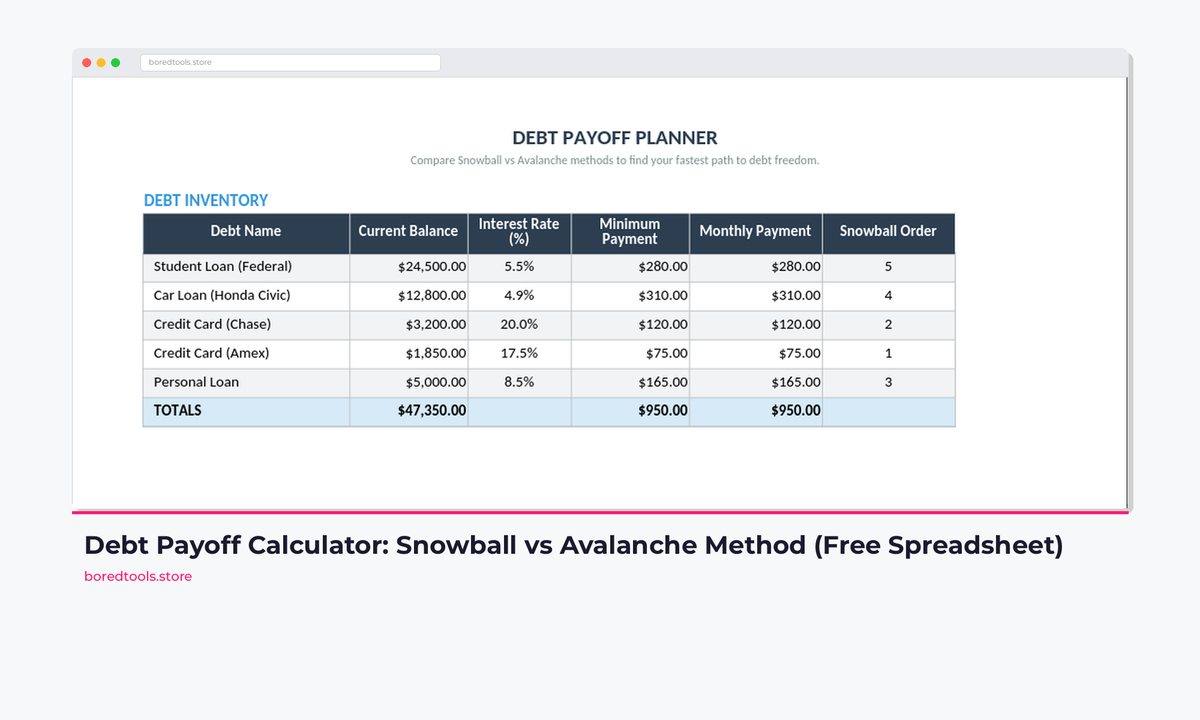
You've got multiple debts. Credit card, car loan, maybe a personal loan or student debt. You're making minimum payments on all of them and it feels like you're going nowhere. Every month the balances barely move.
Two proven methods break that cycle: the debt snowball and the debt avalanche. One saves you more money. The other is easier to stick with. The difference between picking the right one can be thousands of pounds and months of your life.
Let's run the actual numbers.
Already sold? The Budget Dashboard 2026 has both calculators built in. Enter your debts, pick your method, get a full month-by-month payoff schedule. Get it for $7.99 on Payhip →
The Two Methods, Explained
Both methods share the same core idea: make minimum payments on everything except one target debt, which gets every extra pound you can throw at it. Once that target's gone, you roll its payment into the next one. The "snowball" or "avalanche" label is just how you pick which debt goes first.
Debt Snowball (Smallest Balance First)
Dave Ramsey popularised this. Order your debts from smallest balance to largest, then attack the smallest one first.
How it works:
- List all debts from smallest balance to largest
- Make minimum payments on everything
- Throw every extra pound at the smallest debt
- When it's paid off, add that payment to the next smallest
- Repeat until you're debt-free
Why it works psychologically: You get a quick win. Paying off a £400 credit card in two months feels incredible. That momentum carries you through the bigger, harder debts.
Debt Avalanche (Highest Interest First)
The mathematically optimal approach. Order debts by interest rate, highest first.
How it works:
- List all debts from highest interest rate to lowest
- Make minimum payments on everything
- Throw every extra pound at the highest-interest debt
- When it's paid off, add that payment to the next highest
- Repeat until you're debt-free
Why it works mathematically: You kill the most expensive debt first, so you pay less total interest over the entire payoff period.
Real Numbers: A Side-by-Side Comparison
Say you have four debts and can put £500/month total toward debt payments:
| Debt | Balance | Interest Rate | Minimum Payment |
|---|---|---|---|
| Credit Card A | £2,800 | 22.9% | £65 |
| Credit Card B | £800 | 19.9% | £25 |
| Personal Loan | £5,500 | 8.5% | £110 |
| Car Loan | £9,200 | 5.9% | £185 |
Total debt: £18,300
Total minimum payments: £385/month
Extra available: £115/month (£500 total - £385 minimums)
Snowball Order (smallest to largest):
- Credit Card B. £800
- Credit Card A. £2,800
- Personal Loan. £5,500
- Car Loan. £9,200
Avalanche Order (highest interest to lowest):
- Credit Card A. £2,800 (22.9%)
- Credit Card B. £800 (19.9%)
- Personal Loan. £5,500 (8.5%)
- Car Loan. £9,200 (5.9%)
The Results
| Snowball | Avalanche | |
|---|---|---|
| Debt-free date | March 2029 (36 months) | February 2029 (35 months) |
| Total interest paid | £3,842 | £3,421 |
| Interest saved | . | £421 |
| First debt eliminated | Month 6 (Credit Card B) | Month 14 (Credit Card A) |
The avalanche saves £421 and one month. But the snowball gives you a win at month 6 instead of month 14. That's 8 extra months of gritting your teeth before you see any progress. For a lot of people, that gap is where the plan dies.
Want to run these numbers for your own debts? The Budget Dashboard 2026 models both methods side by side. Grab it for $7.99 on Payhip →
Which Method Is Better for You?
Pick Snowball if:
- You've tried to pay off debt before and quit
- You need motivation more than optimisation
- Your interest rates are fairly close together (within 5-8%)
- You have a small debt you can clear in 2-3 months
- You respond well to visible progress
Pick Avalanche if:
- You're disciplined and won't quit regardless of pace
- You have a high-interest debt that's also a large balance (like a £10,000 credit card at 24%)
- The interest rate spread is wide (e.g., 24% credit card vs 4% car loan)
- Saving money matters more than quick wins
- You're comfortable with spreadsheets and trust the maths
Here's the honest take: the difference between snowball and avalanche is usually 1-5% of your total interest paid. The difference between either method and making minimum payments only is enormous. Often 40-60% more interest and years more time. Pick the one you'll actually follow through on. A "suboptimal" method you stick with beats the "optimal" one you abandon in month four. Not even close.
To understand how a debt payoff plan fits into a full budget, see our Budget Dashboard 2026 walkthrough and the zero-based budget template guide.
Building the Calculator in Google Sheets
Here's how to build a debt payoff calculator that models both methods.
Step 1: The Debt Input Table
| A | B | C | D | |
|---|---|---|---|---|
| 1 | Debt Name | Balance | Interest Rate | Min Payment |
| 2 | Credit Card A | 2800 | 22.9% | 65 |
| 3 | Credit Card B | 800 | 19.9% | 25 |
| 4 | Personal Loan | 5500 | 8.5% | 110 |
| 5 | Car Loan | 9200 | 5.9% | 185 |
| 6 | ||||
| 7 | Total Monthly Budget | 500 | ||
| 8 | Extra Payment | =B7-SUM(D2:D5) |

Enter your debts once. The calculator works out your extra payment amount and builds the payoff schedule from there.
Step 2: Snowball Order (Auto-Sorted)
Use SORT to automatically order debts by balance (smallest first):
=SORT(A2:D5, 2, TRUE)
This sorts the debt table by column 2 (balance) in ascending order. Put this in a new section or tab labelled "Snowball."
Step 3: Avalanche Order (Auto-Sorted)
Same formula, sorted by interest rate (highest first):
=SORT(A2:D5, 3, FALSE)
This sorts by column 3 (interest rate) in descending order. Put this in an "Avalanche" section or tab.
Step 4: Monthly Payoff Schedule
This is the core of the calculator. For each month, you need to:
- Calculate interest on each remaining debt:
balance × (annual rate / 12) - Apply minimum payments to all debts
- Apply the extra payment to the target debt
- When a debt hits £0, redirect its minimum payment to the next target
- Track the running balance
Here's a simplified structure for one debt's monthly calculation:
| Month | Starting Balance | Interest | Payment | Ending Balance |
|---|---|---|---|---|
| 1 | 800.00 | 13.27 | 140.00 | 673.27 |
| 2 | 673.27 | 11.16 | 140.00 | 544.43 |
| 3 | 544.43 | 9.03 | 140.00 | 413.46 |
Interest formula: =B2*(rate/12)
Payment: minimum + extra (if this is the target debt)
Ending balance: =MAX(0, B2+C2-D2)
The MAX(0,..) stops the balance going negative when the final payment exceeds the remaining amount.
Step 5: Summary Comparison
Build a side-by-side comparison:
| Snowball | Avalanche | |
|---|---|---|
| Total Months | =calculated | =calculated |
| Total Interest Paid | =SUM of all interest | =SUM of all interest |
| Debt-Free Date | =calculated | =calculated |
| Money Saved | . | =snowball interest - avalanche interest |

The summary comparison shows exactly how many months and how much interest each method costs. Pick with confidence.
The Hybrid Approach
You don't have to pick one method exclusively. Here's a practical approach that works well.
Start with snowball. Clear the 1-2 smallest debts to build momentum and simplify your finances (fewer payments to track). Then switch to avalanche for the remaining larger debts where the interest rate differences actually matter.
Using our example: knock out Credit Card B (£800) first for the quick win, then switch to Credit Card A (£2,800 at 22.9%) before the personal loan (£5,500 at 8.5%).
This hybrid costs you maybe £30 more in interest than pure avalanche but gives you the motivational boost of killing a debt in the first few months. Worth it for most people.
If you pair a debt payoff plan with a solid monthly budget, you'll find extra money faster. The 50/30/20 budget template is a good starting point for seeing where the cash is going.
Accelerating Your Payoff
The method you pick matters less than how much money you throw at your debt. Here's how to increase your monthly payment.
Cut expenses temporarily. Cancel subscriptions, cook at home, skip holidays for one year. This isn't forever. It's a sprint.
Increase income. Side gigs, overtime, selling things you don't use. An extra £200/month cuts years off your payoff timeline.
Use windfalls aggressively. Tax refund, work bonus, birthday money. Dump it on the target debt. A single £1,000 lump sum can wipe out months of payments.
Negotiate interest rates. Call your credit card company and ask for a lower rate. Worst they say is no. Best case, you save hundreds in interest. A balance transfer to a 0% introductory card can save even more. Just watch the transfer fee and clear it before the promotional period ends.
Round up payments. If your minimum payment is £65, pay £100. The extra £35/month compounds significantly over time.
Common Mistakes
Taking on new debt while paying off old debt. This is bailing water out of a boat while someone drills new holes. Freeze the credit cards literally, in a bag of ice if it helps, until you're done.
Not having an emergency fund first. Save £1,000 as a starter emergency fund before aggressively paying debt. Otherwise the first unexpected expense goes right back on the credit card and you lose all momentum.
Paying extra on all debts simultaneously. Spreading £115 across four debts means none of them get cleared quickly. Focus creates momentum. One target at a time.
Forgetting to redirect payments. When Debt #1 is paid off, its payment (minimum + extra) must transfer to Debt #2. That's the "snowball" or "avalanche" effect. If you pocket that freed-up money instead of redirecting it, the method fails.
Related Reads
- Best Budget Spreadsheet Templates in 2026
- The 50/30/20 Budget Rule: Free Google Sheets Template
- How to Track Your Net Worth in Google Sheets
- Budget Template for Couples: How to Manage Money Together
Get the Calculator
Building the full month-by-month payoff schedule with auto-sorting is doable but takes about an hour to get right. The Budget Dashboard 2026 has both calculators already built. Enter your debts, choose your method, and it generates the full payoff schedule with a visual chart showing both methods side by side.
UK edition built for British finances: HMRC Self Assessment categories, council tax tracking, National Insurance (Class 2 and Class 4) calculations, ISA allowances, and GBP formatting throughout. US edition included with IRS tax brackets, 401(k) tracking, and USD formatting.
It's $7.99 one-time. The debt payoff calculator alone is worth that. But it also covers monthly budgeting, net worth tracking, and savings goals. Getting out of debt is step one. Building wealth is step two.
Get the Budget Dashboard 2026 on Payhip →
Pick a method. Start this month. Future you will be grateful.
Get free spreadsheet templates and updates. New templates, feature updates, and practical guides delivered to your inbox. No spam, unsubscribe anytime.
Subscribe free → | Already have a template? Download the free budget tracker or free meal planner. No email required.
Choose the right next step
Need a simple budget tracker spreadsheet? Start with the Free Budget Tracker. Use Budget Dashboard 2026 when you want budgets, debt, savings and net worth in one workbook. Choose the Complete Collection when several parts of life admin need sorting.